In today’s educational landscape, supporting staff supporting children has never been more important. Recognising the importance of the relational connection between educators and children/young people and a deeper understanding of how we all are connected and impact on each other’s nervous systems is very necessary. It also gives us a reminder of the power we have to make a difference to ourselves and each other.
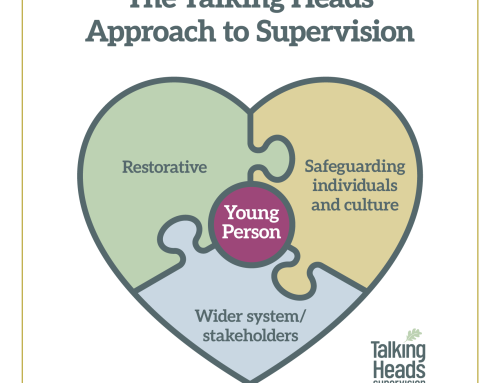
Supervision is a career long professional conversation which is regular, confidential and holds children and young people at its heart. In social work or mental health where supervision is mandatory the beneficiary is always the client. For example, if you work in adult NHS learning disability services as a clinician you take to supervision your work with the adults you serve. Supervision is a place for reflection, growth and one of ethical accountability which recognises the emotional labour of working in a caring way with other human beings. Without the regular safety valve our capacity for clear and complex ethical decision making can become depleted. Super-vision supports our capacity for perspective and in line with our core values. It is clearly linked to individual wellbeing being safeguarded, the children/young people being safeguarded as well as the system and context being supported/challenged.
As the Teacher Wellbeing Index 2025 shows us, the decline in wellbeing amongst educators is presently lower than it was in 2019. There is a year-on-year increased reporting of the need for educators to offer co-regulation to CYP. This has moved from 39% in 2019 –2020 to 70% this academic year. The demand for educators to have emotional (and physical) capacity to undertake their work is therefore evident. Supervision is a process which supports and recognises this emotional labour and its impact if there is no place to untangle it or be supported to gain a “super – vision” in what it is they are “holding”.
With this increasing focus on support comes a growing confusion around the terminology. Words such as coaching, counselling, and supervision are sometimes used interchangeably, despite each offering something very different.
Below is a guide to help educational leaders distinguish between these three important approaches.

Who is the beneficiary of the intervention is the key place to start and is the fundamental simple but profound difference
Duration
Supervision: A Reflective, Safe Space for Professional Thinking
Supervision is increasingly recognised as essential within education, especially in safeguarding. It offers a structured, relational space where staff can think critically about their work, reflect on the emotional impact of that work, and process complex safeguarding/contextual/systemic decisions.
Supervision is neither performance management nor therapy. Instead, it sits at the intersection of emotional containment and professional accountability.
Key features of supervision:
- Reflective and relational – explores how the work affects the individual.
- Protective – strengthens safeguarding decision-making.
- Regular and ongoing – not a one-off conversation but a continuous cycle.
- Grounded in restorative practice – offering thinking time, not fault-finding.
- Focused on patterns, risk, and impact – supporting staff to stay safe and effective.
- Offers relational challenge which is growthful
- Offers capacity for co-regulation within the relationship – it is restorative
Supervision helps professionals pause, make sense of what they are carrying, and consider their work through a wider lens. This is essential in a climate where staff are often under intense emotional and cognitive pressure.
What supervision is not:
- Performance management
- A counselling or therapeutic intervention
- Coaching focused on goals and targets
- A line management meeting
High-quality supervision protects both children and adults — offering clarity, containment, and a safe space to reflect.
Why Understanding the Differences Matters
Although all three approaches share some common skills — listening, reflection, questioning — their purpose, boundaries, and outcomes are different.
When schools differentiate clearly between supervision, counselling, and coaching, they create a culture that is safer, more reflective, and better able to meet the needs of both staff and pupils.
Supervision → for safeguarding reflection, emotional load, and professional thinking.
Coaching → for developing skills, confidence, and professional performance.
Counselling → for emotional wellbeing, mental health, and personal challenges.
Used together — and used wisely — these three approaches form a powerful support system. Staff feel more grounded, more supported, and more able to carry the emotional and ethical weight of the work. And when adults feel secure and reflective, children benefit. We work with many leaders who have both supervision and coaching and realise how having each helps them use the other even more effectively. This is the same when counselling is also in the mix.
We have grown from seeing one Assistant Head Teacher in 2018 to now having a team of 50 Associate Supervisors working all over the UK and seeing over 450 senior leaders for long term, monthly supervision. People stay with us. For deeper insight into supervision in education, please get in touch.